

A gate motor for heavy gates must be matched to the sliding gate’s weight, movement and expected frequency of use. The automation typically combines a motor and control unit with a drive rack, while safety photocells send signals to the control unit to support safer operation. For gates weighing up to 2,000 kg, weight is an important starting point, not the only measure of suitability.
Commercial gates often operate frequently, and a poorly aligned or difficult-to-move gate can affect system performance. In Doha, Dafna, West Bay and The Pearl, Qatar’s heat, dust, coastal conditions and wind exposure can also influence equipment selection and maintenance.
This guide explains how sliding gate automation works and what to assess when choosing a system for a commercial or industrial entrance. Learn how the gate’s condition, usage, safety equipment and site environment affect motor suitability, and when a sliding system may be preferable to a swing gate.
Key Takeaways
- Assess the gate’s condition, travel path and operating frequency alongside its weight before selecting a motor.
- Plan safety measures around the gate’s closing edge and the conditions in which it operates.
- Compare sliding and swing designs by considering available space, gate construction and exposure to wind.
- Learn what to consider when assessing Comunello Qatar’s Fort sliding motor for a commercial entrance.
In summary: how is a sliding gate automation made?
A sliding system combines a motor, control unit, drive rack, gate and safety devices. For a commercial entrance, assess the gate’s weight, movement and operating conditions before selecting components.
Motor Models by Gate Weight
For gates weighing 300-1,500 kg, use the gate’s measured weight to narrow suitable motor options. Then compare that figure with the motor’s documented capacity, rather than selecting by appearance or gate length alone. A gate’s rolling resistance and alignment also affect the load placed on its drive. Check that it moves smoothly by hand before sizing automation.
Sliding Motor Kits and Accessories
A sliding motor kit may include the motor and control unit with a drive rack, while accessories support safe operation and access. Check what the kit includes, then identify any additional photocells, remotes or safety edges the site requires. Swing gates use different drive hardware, so choose accessories designed for the gate’s movement and control system.
During operation, the control unit directs the motor, which moves the gate along the rack. Photocells send signals to the control unit and help improve automation safety. Position and configure safety devices around actual access points, including the closing edge, rather than treating them as optional.
Photocells can detect an obstruction across their beam, while force-sensing devices can help identify resistance during movement. The required safeguards depend on the gate’s design and operating environment. The UK Government states that BS EN 12453:2001 recommends minimum safeguards against crushing at a gate’s closing edge based on its operating environment.
For installations in Qatar, follow applicable local approval requirements and the project’s specified safety standards. A UK standard alone does not establish local compliance. Common causes of failure include track debris, poor alignment, worn rollers and unsuitable motor sizing. Inspect the track and gate movement before commissioning, then test the safety devices and controls.
Commercial and heavy industrial sliding gate motors
At a commercial entrance, repeated opening cycles influence motor suitability alongside the gate’s physical load. A distribution site handling deliveries throughout the day has different operating demands from a staff entrance used mainly at shift changes. Map the busiest access periods and expected traffic pattern, then compare them with the motor manufacturer’s stated operating limits.
The electrical supply must meet the selected motor and control unit’s exact requirements. Battery backup is relevant when continued operation during a power interruption is part of the site’s access plan, but it must be compatible with the automation system. During design, establish how authorised users will enter during an outage and ensure responsible staff understand the manual release procedure.
For a facility serving several vehicle types, consider how gate controls fit the access process. Remote controls, an access-control interface or staffed operation can shape how opening commands are managed. Before installation, confirm the control arrangement suits the operator and the property’s workflow. This helps prevent the gate from becoming a bottleneck at busy times.
Set service frequency according to the motor manufacturer’s maintenance instructions and the actual usage and site conditions. A high-traffic commercial gate needs planned attention, not just repairs after a fault. Keep a service record of observed changes, work completed and parts replaced. This helps facility teams spot recurring issues and plan maintenance around site operations.
During scheduled servicing, include the motor housing, mounting security, electrical connections and control response in the assessment. Qatar’s heat and dust can affect equipment operating conditions, so keep service access clear and report unusual sounds, delays or inconsistent commands promptly. Planned gate maintenance support can help facility teams coordinate these checks with ongoing access requirements.
Motor suitability for gates weighing up to 2,000 kg
A gate weighing up to 2,000 kg needs a motor selected against its documented capacity and operating conditions. Treat the stated weight as one selection factor, not proof of suitability. Compare the gate’s measured mass with the manufacturer’s rating, then assess resistance, travel and expected use before specifying the drive.
Two gates of equal weight can place different demands on automation. A long, poorly aligned gate may create more resistance than a shorter one that rolls freely. First inspect the track, rollers, rack engagement and gate structure. Correct mechanical faults before choosing a more powerful motor, since automation cannot compensate for persistent binding.
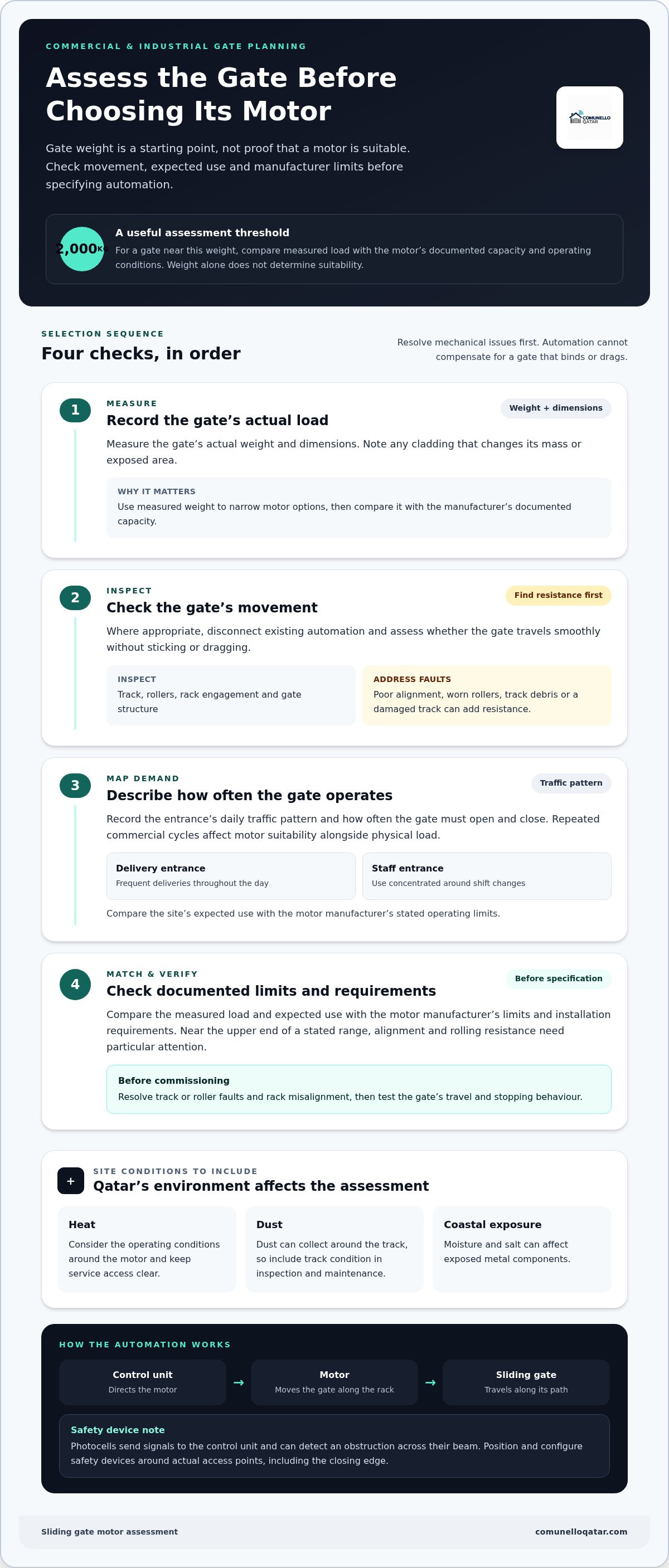
Use this assessment sequence for a gate near the 2,000 kg threshold:
- Measure the gate: record its actual weight and dimensions, and identify any cladding that changes its mass or exposed area.
- Check movement: disconnect existing automation where appropriate, then assess whether the gate travels smoothly without sticking or dragging.
- Review use: describe the entrance’s daily traffic pattern and how often the gate must open and close.
- Match specifications: compare the load and use conditions with the motor manufacturer’s limits and installation requirements.
Near the upper end of a motor’s stated range, alignment and rolling resistance need particular attention. Worn rollers, a damaged track or rack misalignment can increase strain with every movement. Resolve these issues before commissioning, then test the gate’s travel and stopping behaviour.
Qatar’s heat, dust and coastal exposure also affect the installation environment. Dust can collect around the track, while moisture and salt can affect exposed metal components. Consider the motor’s mounting position, enclosure protection and maintenance access alongside its load rating. A suitable choice depends on measured gate weight, sound mechanics, operating demands and the manufacturer’s documented requirements, not weight alone.
What type of gate motor is best for heavy gates: sliding or swing?
Gate weight alone does not determine whether sliding or swing automation is preferable. Compare the site layout, gate construction, available movement space and operating conditions. A sliding gate travels along a track beside the entrance; a swing gate turns on hinges through an arc.
A sliding design can suit a wide entrance if there is room beside the boundary for the gate to retract. The track and supporting ground need to provide a stable, clear path. A sloped or uneven entrance, for example, may complicate travel and require careful layout planning. Measure the full opening and the space beside it before choosing this arrangement.
A swing gate may suit a property with enough clearance in front of or behind the entrance. Its leaves need room to open without striking vehicles, walls or landscaping. Hinges and gate posts carry the movement loads, so their condition and structural support matter. With a two-leaf design, each leaf’s dimensions and movement must suit its actuator.
Wind exposure also matters when comparing gate types. A broad, close-boarded hinged gate presents a large surface to the wind. The UK Government notes that wind loads on close-boarded hinged gates can exceed what their drive motors can overcome. An open or partially open design changes the exposure, but actual site conditions still matter.
Use these checks to guide the choice:
- Check space: confirm the sliding path or swing arc stays clear of vehicles and structures.
- Inspect supports: assess track foundations for sliding designs and posts and hinges for swing designs.
- Consider wind: account for gate surface area and the entrance’s exposure.
- Match use: assess access patterns and expected operation before specifying the motor.
For a commercial entrance, compare both layouts against the gate’s construction and site plan. Arrange a gate layout assessment to identify which automation type best fits the entrance.
Comunello Qatar: Comunello Fort 1500kg Sliding Gate Motor
The Comunello Fort 1500kg Sliding Gate Motor is a sliding-gate option for applications within its stated weight class. Its name indicates a 1,500 kg rating, so it should not be treated as suitable for a gate weighing 2,000 kg. Gate condition, movement resistance and frequency of use also matter when assessing suitability.
For a gate within the motor’s rating, Comunello Qatar provides equipment selection support, installation and commissioning. The assessment considers the gate’s travel path, site conditions and safety devices, including photocells where appropriate. This helps match the system to the actual entrance, rather than relying on weight alone.
If the gate is hinged rather than sliding, swing options include the Comunello RAM 300 230V Swing Gate Motor, Comunello Abacus 300 230V Swing Gate Motor and Proteco Swing Gate Motor. Contact Comunello Qatar to discuss the gate and its operating requirements.
Plan the right automation for your entrance
Choosing a gate motor for heavy gates is a site decision, not simply a weight comparison. Before specifying equipment, bring together the gate dimensions, movement pattern, entrance layout and operating conditions. This gives the assessment a practical basis and helps match the automation to how the property is used.
For a sliding installation, Comunello Qatar offers the Comunello Fort 1500kg Sliding Gate Motor. Swing-gate options include the Comunello RAM 300 230V Swing Gate Motor and Comunello Abacus 300 230V Swing Gate Motor. The appropriate model depends on the gate design and its demands, so use the site details to guide the discussion rather than relying on the model name alone.
Facility managers, contractors and property owners can prepare by noting changes in gate movement, access demands or exposure to dust and coastal conditions. These details help focus the next discussion on system suitability, installation and ongoing care.
Contact Comunello Qatar about gate motors to discuss the requirements of your entrance and identify a considered next step.
Frequently Asked Questions
What are automatic systems for sliding gates?
Gate controls let authorised users open or close a sliding gate using a chosen method. A residential property may use remote operation, while a commercial entrance may need access controls that fit staff or visitor procedures. Decide who needs access and how permissions should be managed before choosing the control arrangement. Responsible users should also understand the gate’s manual release procedure.
How do you calculate the required gate motor capacity from gate weight and length?
There is no reliable formula based only on weight and length. Record the complete gate’s measured mass and overall length separately, since its full length may exceed the clear opening. Compare those measurements with the selected motor’s manufacturer data. Include the gate’s use pattern in the assessment, and do not substitute a rating from another model.
What motor force or weight rating is recommended for heavy residential and commercial gates?
Choose a rating that covers the gate’s measured mass under the manufacturer’s stated operating conditions. Residential and commercial applications can have different usage demands, so weight alone cannot identify the right model. Review the model documentation for its intended application and operating limits. A gate near the published maximum needs particular care when matching the exact model to the installation.
Which gate motor brands and models are reliable for heavy gates?
Assess reliability model by model using published specifications and practical ownership considerations. Review the manufacturer’s documentation, the availability of compatible spare parts, and access to repair and maintenance support in Qatar. Check whether the product’s stated limits suit the gate and its operating pattern. A recognised brand name alone does not show that a specific operator suits the installation.
How do you install and set up an operator for a heavy gate?
Use an installer familiar with the selected operator and the site’s access requirements. Before work begins, coordinate with property staff so vehicle access and user permissions are managed appropriately. At handover, request the operating instructions, control-user details and maintenance guidance. Keep these records with the gate’s service history, especially at commercial sites with several responsible staff.
What power supply, battery backup, and electrical requirements do heavy gate motors need?
The electrical supply must meet the selected motor and control unit’s exact requirements. If the gate needs to operate during a power interruption, use a compatible battery backup and plan how authorised users will enter. Responsible staff should understand the manual release procedure.
